
My Wife Was Right About Everything
The Unfashionable Case for Giving a Sh*t

My wife is one of the most earnest people I have ever met.
I mean that as the highest possible compliment, though I’ll admit it took me a while to regain my love for all things earnest. Isobel is a documentary journalist (who’s won 11 Emmy’s), and she cares about the work in a way that is almost inconvenient. She doesn’t do cynicism. She doesn’t do the knowing, world-weary shrug that a lot of us in the media slip into to protect ourselves. When she reports on something, it’s because she genuinely believes that getting the truth in front of people might change something. That telling a story properly is worth the cost of telling it.
For a long time I found that slightly naive. My time in the industry started with spades of earnestness, but it was subtly, gradually, eroded by sceptic media types who think everything has to be a commercial decision or have some Machiavellian ulterior motive. I had spent years in an industry where you learn very quickly to talk about “impact” in award or funding applications and then quietly forget about it the moment the commission comes through. Earnestness, in a lot of professional rooms, is treated as a thing you grow out of.
“Maybe he’s a little TOO earnest”
But lately I’ve come round to thinking it’s the only thing that actually matters.
This has been on my mind for a specific reason this week.
In October last year we released a documentary called Breaking Ranks: Inside Israel’s War in collaboration with ITV. It featured testimony from Israeli soldiers describing what they had seen and done in Gaza. It was a difficult film to make and a difficult film to put out. Getting people to speak on the record about something like that is slow, careful, frightening work, and there were plenty of moments where it would have been easier not to.
This month, a UN commission of inquiry published a major report on the war, concluding that Israel had committed genocide against children in Gaza. Among the many sources it drew on, testimony from our documentary was cited as part of the documented record.
I’m not telling you this to take credit for anything. The credit belongs to the people who spoke, and to the journalists and investigators who have spent years documenting all of this at enormous personal cost. Our film was one tiny contribution among countless others. But it did remind me, very clearly, why we do this at all.
You make a film. You put it out. And sometimes, quietly, it becomes part of how the world establishes what actually happened. That is the real power of documentaries. Not the views, not the awards, not the deals. The record. The simple, stubborn act of getting something true in front of people who might otherwise never have seen it.
That’s earnestness. And it turns out my wife was right about it the whole time.
(Thank you as well to the Zandland team for reminding me that the things we do can actually make a difference)
On Sunday, I sat with that very same wife (she’s getting a lot of shoutouts in this newsletter) to watch Daniel Roher’s documentary on Artificial Intelligence, The AI Doc, and it actually left me thinking a lot about earnestness… It’s worth a watch. But it was less the film itself that stuck with me than the feeling it left me with afterwards, about the world we’re walking into and how fast it’s arriving.
Because we are living through one of the most radical periods of change in human history, and the people steering most of it are not, on the whole, earnest. The systems being built right now are extraordinary, but their incentives are not. They are built to optimise, to engage, to retain, to predict what you’ll click and serve you more of it. They are not built to care whether something is true, or whether telling the truth makes the world fractionally better. And the handful of people building them, the techno-billionaires reshaping how billions of us live, talk endlessly about improving humanity while operating on incentives that have very little to do with it.
I’m not one to be cynical about technology. A lot of it is genuinely miraculous, and I use it every day. But I’ve started to feel that in a world increasingly mediated by machines optimised for engagement, and shaped by a small number of people optimised for power and wealth, the genuinely human impulse to make something simply because it should exist, because the truth deserves to be told, because someone needs to see this, becomes more valuable, not less. Maybe it becomes the most valuable thing we have.
An unvarnished, slightly embarrassing, completely earnest ambition to just make things better. To do something because of the value it provides, not the return it generates. That used to be the default reason people made documentaries. I think it’s now a slightly radical one.
It also makes you realise how fragile all of this is. The world we take for granted, the ability to make work freely, to publish it, to reach people directly, to hold power to account without asking permission, none of that is guaranteed. It could be narrowed or taken from us faster than we’d like to think. Which is all the more reason to use it now, properly, while we have it.
So that’s where my head is at as we head into the next few films.
The next one I want to tell you about is a complete change of pace, and deliberately so. It’s a film about money, and the unimaginable distance between those who have it and those who don’t.
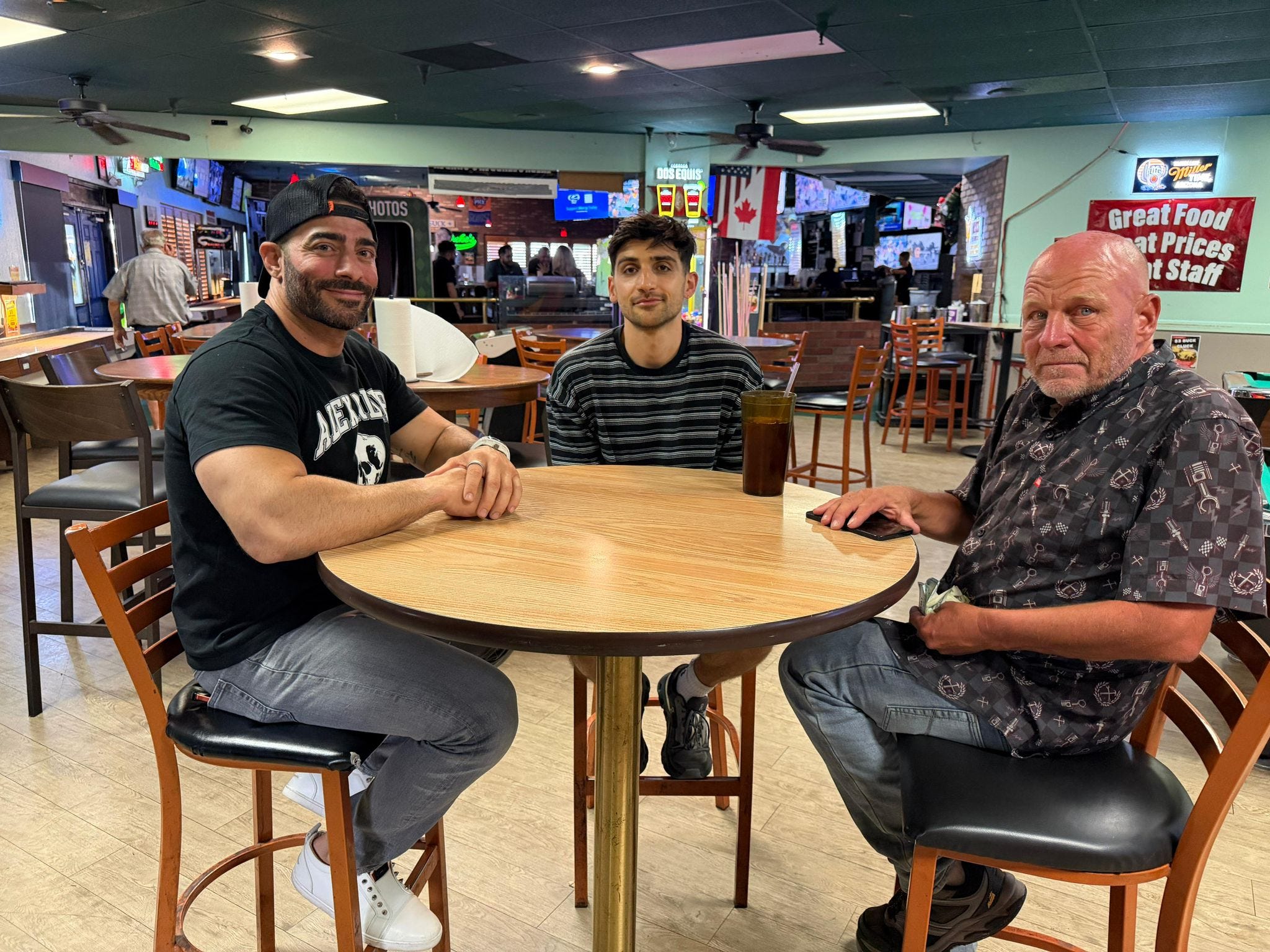
I went to Scottsdale, Arizona, which has the fastest growing millionaire population in America, and also, fifteen minutes down the road, one of its worst homelessness crises. The same stretch of desert, the same searing heat, two completely different realities. I wanted to find someone from each end of that divide and bring them together, to see what, if anything, two people that far apart could actually learn from each other.
On one side was Larry, a disabled veteran sleeping on the patio of a sports bar, who writes poetry and once gave away his last twenty dollars because someone needed it more than he did. On the other was Mike, a self-made millionaire with a Lamborghini and a movie theatre in his house, who told me that he doesn’t believe income inequality exists.
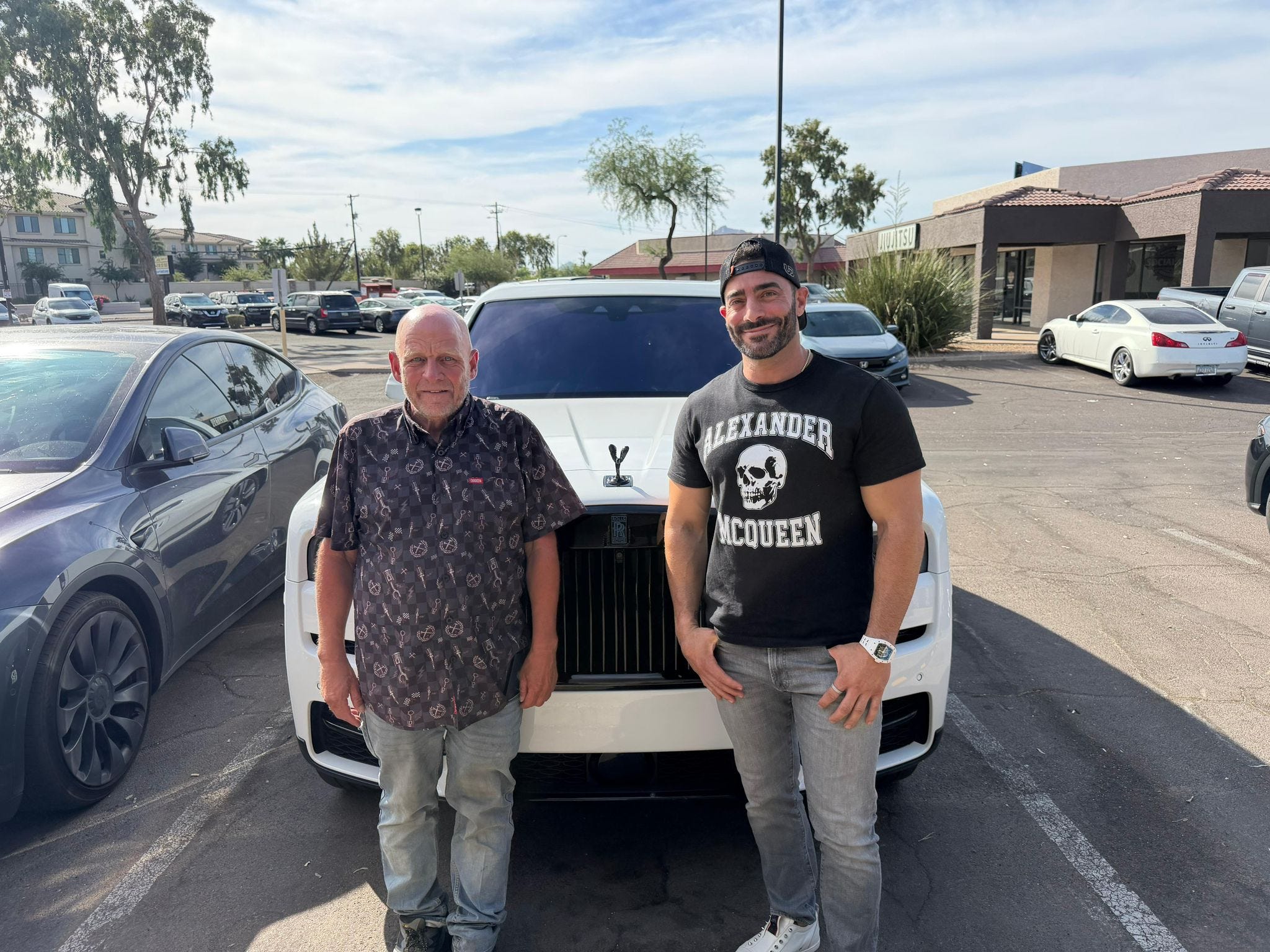
What happened when they met was a conversation I don’t think I’ve seen before. The film’s probably earnest in exactly the way I’ve been describing. It doesn’t lecture, it doesn’t tell you what to feel, it just puts two human beings in a room and lets you watch.
It’ll be live this Thursday on our YouTube channel.
In the meantime, if you haven’t seen Breaking Ranks, it’s available internationally on our YouTube channel. It’s not an easy watch. But we’re proud of it.
In conclusion: you have to do things that matter. Otherwise, why the hell are we doing any of this at all?
Speak soon!
Ben
I’ve tried not giving a shit. It turns out it’s a great way to produce not very good work. I like working with earnest people, they make fewer mistakes, are more fearless, go that extra yard every time.