

This Thursday, our next film goes up on our YouTube, a documentary with exclusive access inside a US jail. That same afternoon, I’m doing a sneak peek of the film at SXSW London, and talking about the changing rules of documentary and where Zandland sits in the middle of that change.
The thing I’ll probably end up talking about on stage is the question I get asked more than anything else: how do you build a company in this new media environment, what’s the algorithmic strategy, how do you hack the platforms? So I want to use this issue to say what I actually think about that, and how it threads through everything we’re doing this week.
Part One: The Media
Building for the long game in a short-game industry
The honest answer to the question of how to build a company in this environment is that I don’t really think about it in algorithm-first terms.
The frame I’ve used for a long time, in my own life and at Zandland, is a little bit more philosophical… Who do I want to be at 80, looking back? What’s the story I want to be able to tell? Each piece of work isn’t really a piece of work in isolation. It’s a thread in a longer tapestry, the life of Zandland and the people who make it. And so the question I ask of every decision isn’t will this perform (though I do obviously care about that), it’s something closer to what does this actually say about us, and about me, and could I explain it to my kids in ten years’ time.
That sounds soft and a little bit woo woo, but it’s a more demanding filter than the algorithmic one. The algorithm rewards a film that does numbers this week. The ten-year filter asks whether the film is something you’d still be proud of when the numbers no longer mean anything and the algorithm inevitably changes… and that includes how you made it, who you worked with, how contributors were treated, whether the team enjoyed it, whether the editorial line held up under scrutiny.
It runs counter to a lot of the standard advice. Faster, louder, more frequent, more confident, more polarising. The platforms reward all of that. But what I’ve come to believe, and the reason I’m willing to operate this way commercially, is that the long-game eventually builds two things the short-game can’t.
The first is trust. Trust is what audiences are increasingly hungry for in a media environment where confidence is cheap, certainty is manufactured, and the gap between what’s said on camera and what’s actually true keeps widening.
The second is the energy to keep going. Any ambitious endeavour runs on energy, the energy to try new things, to recover when something inevitably fails, to come back the next day and start again. The only way I’ve found to sustain that is to actually be content with the work you’re doing, and the way you’re doing it. Short-game wins don’t generate that. You can hit numbers and still feel hollow. Long-game work is harder to make and slower to reward, but it gives you something to stand on.
This isn’t a moral argument. It’s a strategic one. The companies trying to win on volume are competing with infinite supply. The companies willing to compete on trust over a long enough timeline are competing with almost no one, and the people inside those companies stand a better chance of still wanting to be there in five years.
The thinking doesn’t really change what we make. We’ll always do a mix, some dark, some funny, some serious, some strange. What it changes is how. How we approach contributors. How we work with the team. How we make decisions when there’s a quick win on the table that would compromise the longer thing we’re building. We don’t always get this right, partly because we’re often doing things for the first time, we deliberately keep stretching into territory that makes us uncomfortable. But I genuinely think the cumulative effect of operating this way pays off, both for the company we’re building and for being able to look at it without flinching.
Part Two: The Work
Speaking to a Convicted Murderer Inside Weld County Jail
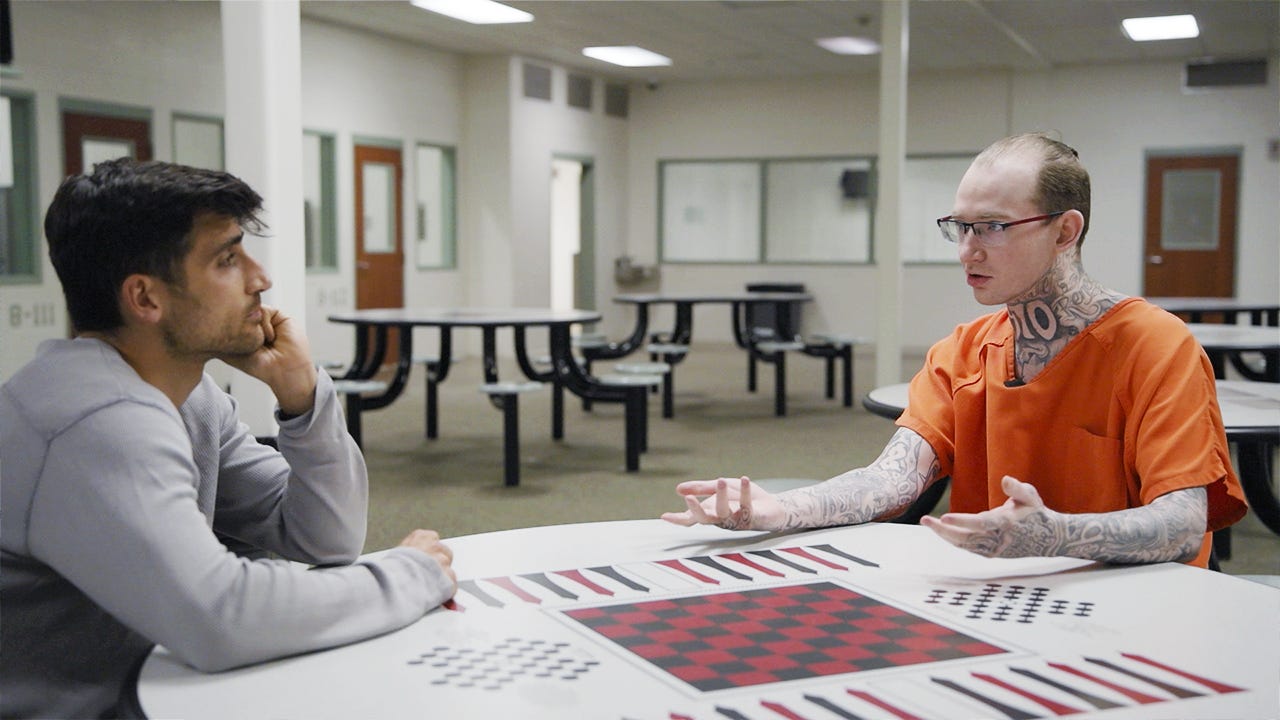
The film we’re showing Thursday is a test of that approach, and a useful test of its limits.
We spent a week inside Weld County Jail in Greeley, Colorado, working from minimum to maximum security. The jail has held some of the most infamous killers in modern American history, Chris Watts, who murdered his pregnant wife and two daughters, was held in this unit. We didn’t go in to take a position on the US judicial system or on any of the men and women inside. We went in to spend the time and see what was there.
A week is short. It’s a fraction of what serious long-form reporting on incarceration deserves, and I felt the constraint every day we were inside. But a week is also more than most coverage of these places ever gets, and in that time you see things that don’t survive the trip into mainstream framing.
Five minutes before I met Chandler, in for stealing cars and harassment, on his sixth month inside, he’d got off the phone with his lawyer. “My offer’s 24 years right now. I told them I’ll take 8 in a halfway house and they told me no.” The number was real. We were standing in front of it as he was still doing the arithmetic of the rest of his life.
I met James Ochoa, who has been in and out of the jail for forty years and is now facing a second-degree murder charge involving his own father. I couldn’t ask him whether he did it, he was awaiting trial, but I asked him whether he thought he was a bad guy. “No,” he said. “Regardless.” He believed there was a plan. He was scared.
I met Kyle Moore in his first ever interview. Convicted of first-degree murder, second-degree murder, and four aggravated armed robberies. The man who died in his case was the former partner of his own uncle. He grew up surrounded by addiction, gang involvement, and incarceration as the standard arc of male adulthood in his family. “I was raised in the mentality that we go to prison,” he said. “It’s just part of what we do.”
I met Brittany, 33 years old, who’d been in and out of the system since she was 18. “Sixteen times, maybe.” Her plan, if she got out, was to leave Greeley, because everyone she knew was here, and she didn’t think she could stay clean if she stayed near them.
None of these are stories with thesis statements. None of them resolve. None of them tell you whether the system is broken or working. They tell you who’s inside it, in the specific moment we were there, and what they sound like when someone sits and listens for longer than a soundbite needs.
This is what I mean by the long-game filter shaping how rather than what. The story itself, a jail, murder cases, addiction, the cycle of incarceration, sits squarely inside the kind of dark territory we’ve worked in before. What the long-game thinking changes is the approach. Going in without a pre-written thesis. Letting people talk in their own time. Not pushing for the dramatic line when the patient line is more honest. The film still has a super compelling hook, and feels important to watch. It also may not go as viral as a faster, harder-edged cut would. But it’s the film we feel is the right one to make.
And about the SXSW London conversation
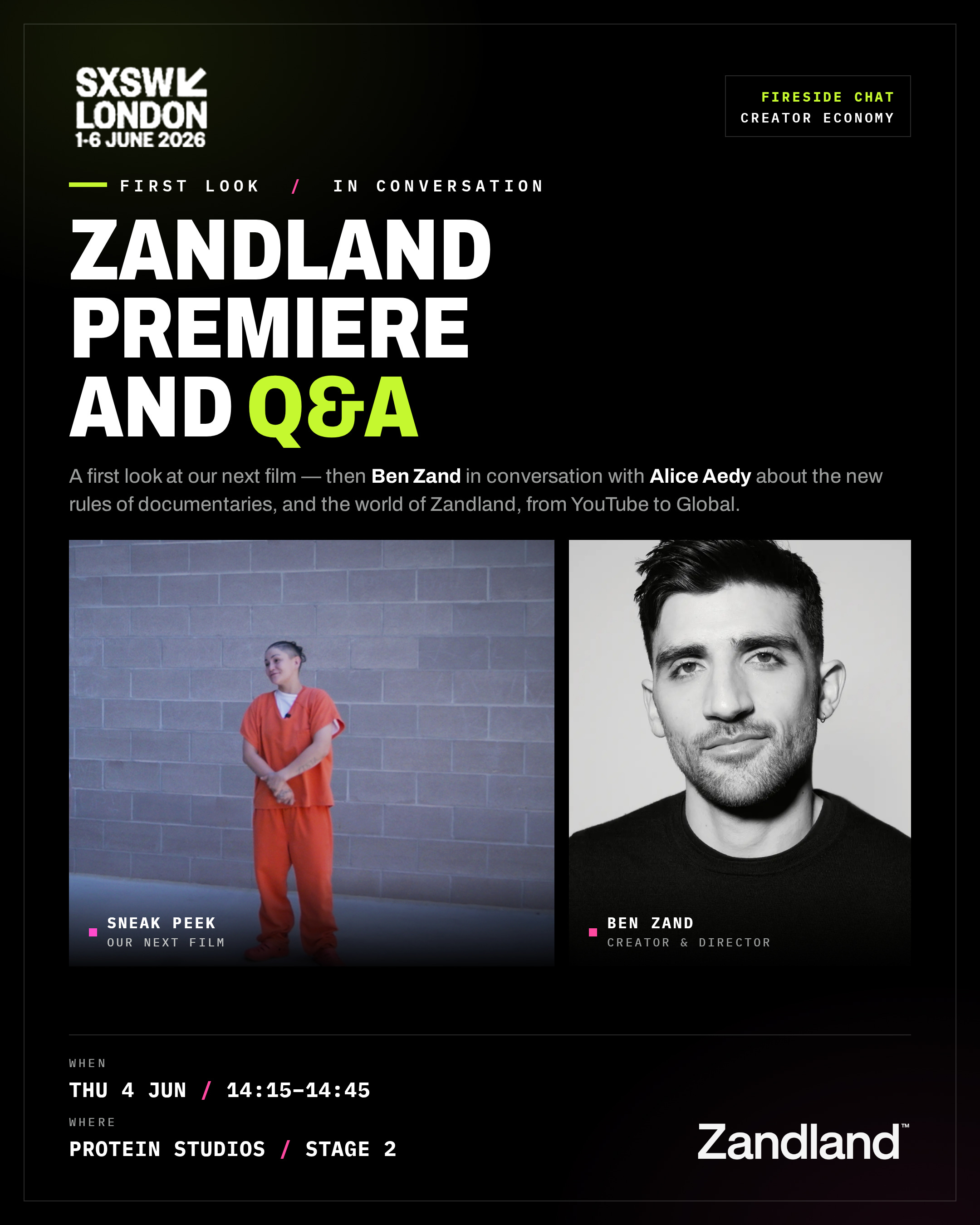
The sneak peek and Q&A is on Thursday at South by South West London, 14:15, Protein Studios, Stage 2, Shoreditch. I’m in conversation with Alice Aedy, filmmaker whose work I really respect, about the changing rules of documentary, what works now, what’s stopped working, and where independent studios fit in.
If you’re at the festival, come along.
The full film goes up on Zandland’s YouTube at 5pm on Thursday.
If someone forwarded you this and you want more, you can subscribe at newsletter.zand.land.
— Ben