
The World According to Zandland - Issue #11
Does Storytelling Actually Achieve Anything?

This week something slightly surreal happened.
A Zandland documentary about a strange internet subculture suddenly ended up on The Daily Show, with the clip racking up millions of views online and more than 600,000 likes across social media.
At almost the exact same time, we were finishing an episode of our new weekly show, The Zandland Show, about one of the most devastating (Oscar-nominated) war stories I’ve encountered in years.
Two completely different worlds.
One exploding across the internet.
The other asking a much heavier question about journalism, war and whether storytelling can actually change anything.
And it got me thinking about something that’s been sitting in the back of my mind for a while:
Does journalism even matter anymore?
A strange moment for journalism
We’re living through a huge shift in media.
Independent creators now have audiences that once belonged to broadcasters.
AI is transforming how information is produced and distributed.
Anyone with a phone can publish and call themselves a journalist.
And yet at the same time, trust in journalism is collapsing.
In the UK, only 27% of people say they trust journalists to tell the truth, according to the Office for Statistics Regulation. Trust in media organisations themselves is even lower.
So we’ve reached a strange moment:
There is more information than ever before.
More commentary.
More voices.
More “news”.
But often less trust, less clarity and less sense that any of it leads to real accountability.
If you’re someone trying to build a journalistic documentary company inside that environment, which I am - it raises a tricky question:
Is any of this actually worth anything? At Zandland we’ve spent years doing investigative work. We’ve taken on some of the world’s biggest companies, we’ve gone inside places powerful institutions didn’t want journalists entering.
We’ve made films like Breaking Ranks, where Israeli soldiers speak publicly about what they did in Gaza.
But even after doing all that, I still very often find myself wondering:
Does journalism genuinely change anything?
Or are we just documenting the world burning in increasingly polished formats?
When journalism does change things
Ok, let’s establish early on that journalism can make a difference.
Sometimes a huge one.
Take the Panama Papers investigation in 2016.
Journalists analysed more than 11 million leaked documents showing how political leaders and wealthy elites were hiding money in offshore tax havens.
The fallout was enormous.
The Prime Minister of Iceland resigned.
The Prime Minister of Pakistan resigned.
Governments across the world launched investigations.
Hundreds of millions of dollars in fines and back taxes were recovered.
Or take the Cambridge Analytica scandal.
Investigative reporting revealed how data from 87 million Facebook users had been harvested without their consent.
Within days:
Facebook lost over $100 billion in market value.
Mark Zuckerberg was summoned to testify before Congress.
The company was eventually hit with a $5 billion FTC fine.
Cambridge Analytica collapsed.
Then there’s the reporting on Jeffrey Epstein.
The Miami Herald journalist Julie K. Brown spent a year digging through court records and tracking down victims for a series called Perversion of Justice.
Seven months later Epstein was arrested on sex trafficking charges, and the US Secretary of Labour resigned over his role in Epstein’s earlier plea deal.
It’s worth saying the Epstein story is both a positive and a negative example for journalism.
On one hand, it’s proof that journalism can work. Persistent reporting eventually forced a case that had been quietly buried back into the public eye.
But it’s also a huge reason for the distrust we see today.
Because the story revealed that many of the people connected to Epstein were sitting right at the heart of our political, financial and technological systems. The case was effectively swept under the rug for years, and the same kinds of powerful figures who appeared in those files are often the ones leading the institutions, and even the platforms, where information and public debate now happen.
For a lot of people, that doesn’t just look like a scandal. It looks like the system protecting itself.
So the idea that journalism never changes anything obviously isn’t true.
But when it works, it tends to work for a few specific reasons.
It’s deeply researched.
It lands at the right cultural moment.
And crucially, it has narrative power.
Because facts matter.
But stories are what make people care.
Side note: one worrying signal right now is that the kind of journalism required to produce those stories is becoming harder to sustain. Institutions that historically funded long, forensic investigations are weakening. Newsrooms like The Washington Post have been heavily gutted, and local news outlets across the US and Europe continue to shut down. Those were often the places where slow, patient reporting began. At the same time, funding for investigative journalism and serious documentary work is becoming more complex and fragile. If the economic foundations for that work continue to erode, the kinds of investigations that expose corruption, crime and abuse of power may simply become rarer, which is not a good signal for truth in the world.
The power of storytelling
So onto this week’s upcoming episode of The Zandland Show.
The film is called The Voice of Hind Rajab, directed by Kaouther Ben Hania (and executive produced by Brad Pitt and Joaquin Phoenix).
It tells the story of Hind Rajab, a six-year-old Palestinian girl trapped inside a car in Gaza after her family had been killed.
The film is built around the real emergency phone call Hind made to the Red Crescent while hiding in the car.
Listening to that audio is almost unbearable.
But it also makes the story impossible to ignore.
The film received a 23-minute standing ovation at the Venice Film Festival and has since been screened at the United Nations, the European Parliament and the UK Parliament.
When I interviewed Kaouther for The Zandland Show, she said something that stuck with me.
She explained that she made the film as a call to action.
But she also said something else that I think gets closer to the truth of how storytelling works:
Maybe storytelling doesn’t change the world directly.
But it can change the way people see the world.
And that distinction matters.
Because journalism rarely flips a switch overnight.
What it does instead is slowly shift the way people understand reality.
And once enough people see the world differently, politics and culture eventually follow.
Meanwhile… the internet is doing its thing
Earlier I mentioned that something slightly strange happened this week.
Our Gooning documentary was picked up by The Daily Show, and the clip has now been viewed millions of times across social media with more than 600,000 likes.
Which is a very odd sentence to write in the same newsletter where we’re discussing investigative journalism, war crimes and documentary storytelling.
But it also says something real about the media environment now.
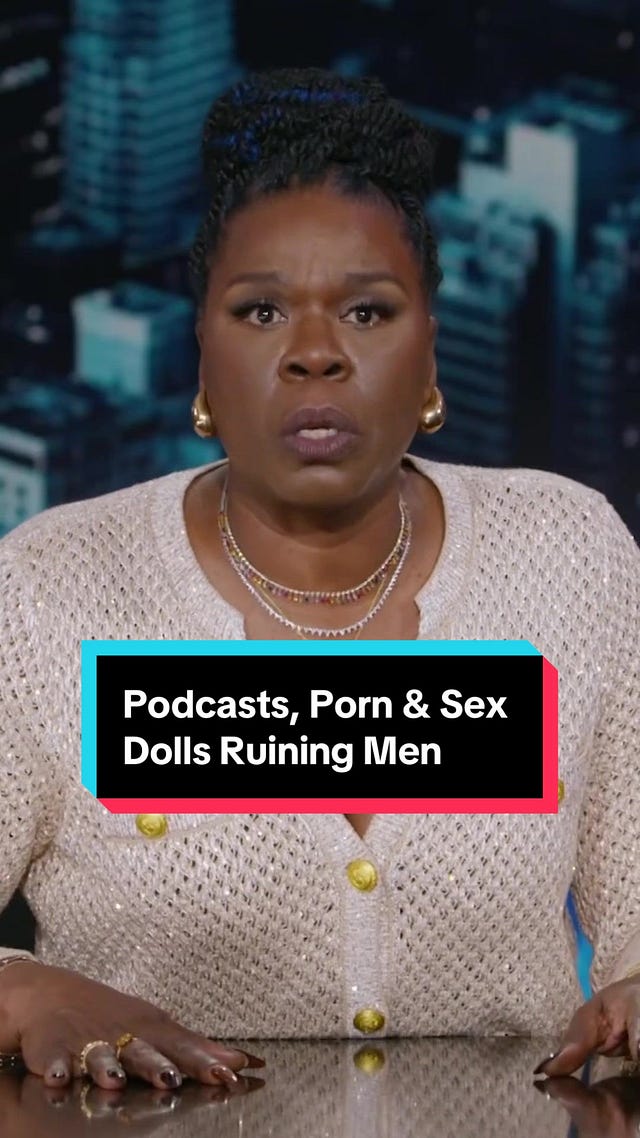
 Tiktok failed to load.
Enable 3rd party cookies or use another browser
A documentary about an obscure and unsettling online subculture can suddenly explode into mainstream culture.
A serious conversation about journalism can sit alongside that.
A film like The Voice of Hind Rajab can be screened at the United Nations.
All of these things now exist in the same ecosystem.
That ecosystem is chaotic.
But it also creates opportunity.
Because independent studios and journalists no longer need permission from traditional gatekeepers to reach people.
What we’re trying to build
That’s really the thinking behind The Zandland Show.
It’s a weekly space where we can talk directly to the audience about the stories shaping the world, and the deeper questions behind them.
Not just one-off documentaries. Not just reacting to headlines.
But building an ongoing conversation about journalism, power and culture.
More broadly, it’s also what we’re trying to build at Zandland.
A company that takes people somewhere they wouldn’t otherwise get to go. Shows them something they wouldn’t otherwise see. And does it in a way that is fair, accurate and emotionally honest. Sometimes that means investigating powerful companies. Sometimes it means speaking to soldiers about the realities of war.
Sometimes it means exploring strange corners of internet culture before they spill into the mainstream.
But the goal underneath all of it is the same.
To help people understand the world a little more clearly.
Thursday
This Thursday we’ll release the latest episode of The Zandland Show, featuring my interview with Kaouther Ben Hania, director of The Voice of Hind Rajab.
If you’ve ever found yourself wondering whether journalism still has any real power, I think you’ll find it an interesting conversation.
And if you want to support the kind of work we’re trying to do at Zandland, the simplest thing you can do is subscribe, share the work, and help us keep building an audience that actually cares about understanding the world.
—
Ben Zand
Fyi i investigated Farage's friend polymarket portfolio https://nimnim1.substack.com/p/george-cottrell-worst-month-on-polymarket