

Last month, a YouTube video about alleged fraud in Minnesota exploded online.
The creator, Nick Shirley, was praised by US Vice President JD Vance, who wrote on X that Shirley had done “far more useful journalism than any of the winners of the 2024 Pulitzer Prizes.”
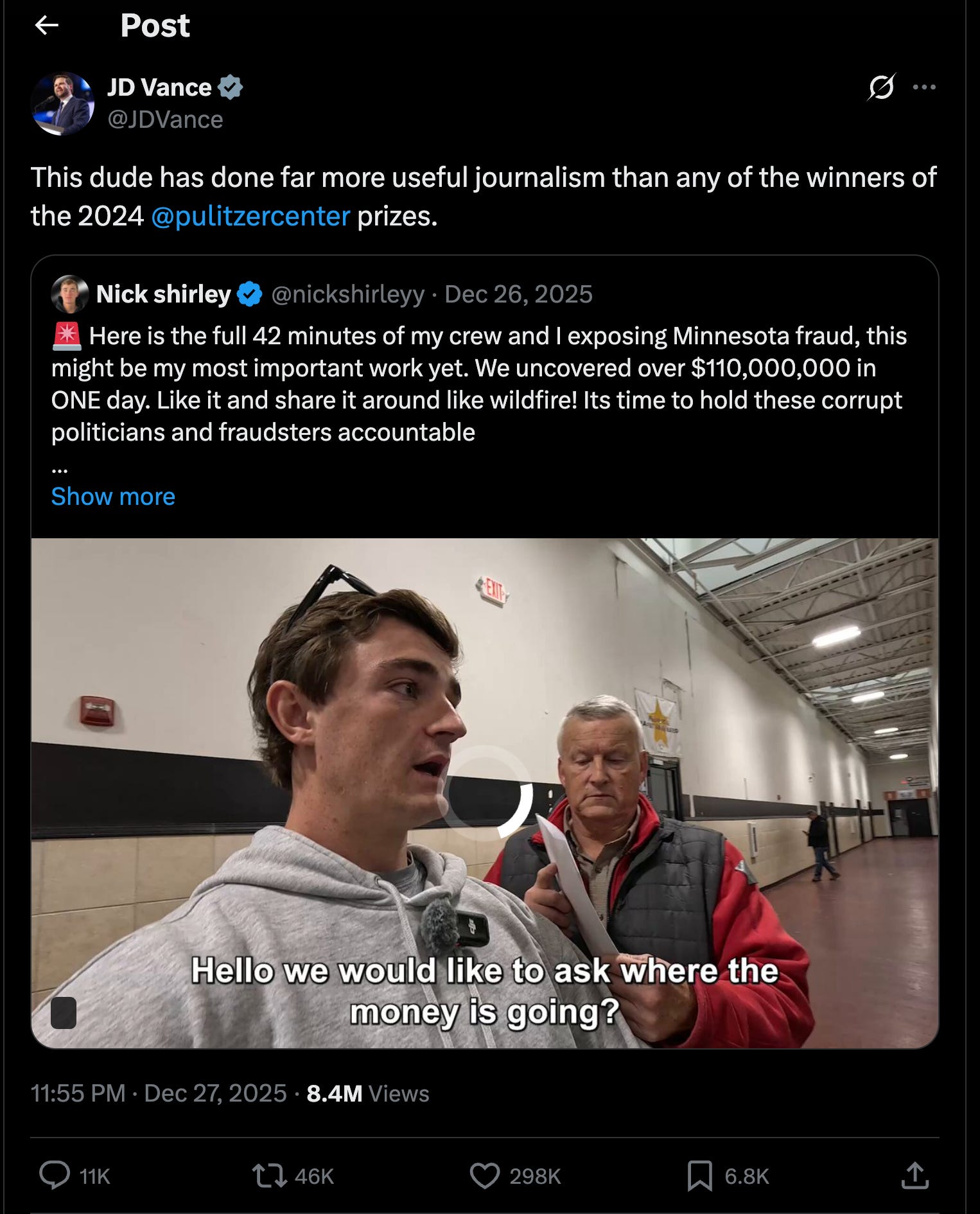
Elon Musk also sent his support, tweeting:
“…fraudsters want to kill him for telling the truth”
The video racked up hundreds of millions of views across platforms. Government agencies responded. Public opinion hardened quickly.
That moment has stayed with me, not because Nick Shirley’s video appeared out of nowhere, but because of what it revealed about the media environment we’re now living in.
Nick Shirley is one of a growing number of YouTubers presenting themselves as journalists, using entertainment, simplicity and confidence as a substitute for investigation, nuance and care. A common theme of this style is the creation of clear battle-lines, positioning “the people” against “the media”, rather than an attempt to understand what’s actually happening.
Responding to criticism of his video, Shirley tweeted:
"Mainstream media is more mad at me then they are at the FACT that billions of YOUR dollars are being used for fraudulent business,"..."I am not an enemy of the people, they are. I'm with you, they are against you."
That tweet drew praise from the infamous Alex Jones — someone who has been repeatedly shown, in court and through extensive reporting, to be a serial propagator of falsehoods rather than an actual seeker of truth. That alignment matters, not because it proves Shirley’s intent, but because it reveals the ecosystem his work now circulates within.
This genre of videos often touch on real issues. Sometimes they even surface genuine wrongdoing. But the trade-off is consistent: complexity collapses, assumptions harden into conclusions, and the human consequences, particularly for people filmed or implicated — are rarely considered.
But this isn’t just about one creator. It’s a broader pattern that represents a new industry.
The age of certainty
Alongside creator-led “investigations,” we now have a shinier, more respectable industry of confidence, a parallel economy of political commentary and media analysis. Podcasts, panels, Substacks and TV hits where the primary product isn’t reporting, but interpretation — where confidence is rewarded far more than accuracy, and certainty is treated as insight.
Everyone is searching for answers from someone who sounds like they know.
But here’s the uncomfortable truth: human beings cannot predict the future, so certainty is pretty much always a performance.
There’s a substantial body of research on political judgement and forecasting, most famously synthesised by Philip Tetlock and revisited repeatedly since, that shows how weak confident expertise often is in practice:
Expert predictions about political outcomes are frequently no more accurate than chance
The more confident an expert appears, the less accurate their predictions tend to be
Prestige, access and experience don’t reliably improve accuracy — they mostly increase overconfidence
This research isn’t new. What is new is a media environment that actively selects for the very traits, confidence, simplicity, certainty, that make getting to the truth harder, not easier. An ecosystem that rewards speed, explanation and performance over evidence, verification and humility.
Why this matters now
What makes the Nick Shirley moment significant, and the broader rise of confidently opinionated podcasts, isn’t any single example. It’s the fact that senior politicians publicly frame this kind of content as better than institutional journalism.
That framing matters. Because it signals a shift in how journalism is being judged: not by accuracy, sourcing or duty of care, but by impact, virality and how well it aligns with what audiences already believe.
And in that world, “vibes journalism”, walk-and-talk videos, live counters, sweeping claims delivered with confidence, will almost always outperform slower, messier, evidence-led truth-seeking.
Enter the BBC
Which is why a recent announcement from the BBC feels important.
The BBC in the UK has now, very belatedly, confirmed a major push into YouTube, producing original, platform-native content aimed at younger audiences.
And first, just to be clear: I don’t think the BBC is perfect. Far from it. I also don’t think the future of trust and truth online sits solely with legacy organisations that have made serious mistakes and often move too slowly.
But the BBC’s intent matters.
Its stated commitment to impartiality, evidence and editorial process sits almost entirely at odds with the incentives of YouTube. And that tension is the point.
The risk is obvious: that this becomes a pensioner trying to look cool on a platform it doesn’t fully understand, retrofitting formats that were invented years earlier by creators operating under very different incentives.
The opportunity, though, is bigger.
If the BBC can resist simply copying what already works, and instead carve out a genuinely new lane, it could help re-establish the idea that truth, complexity and restraint still have a place online.
Doing that will require real risk-taking: patience to iterate, tolerance for early failure, and — crucially — trust in the producers and creators it chooses to back. Not micromanaging them into safety, but giving them the freedom to experiment within clear editorial principles.
That kind of trust is hard for any large institution. But without it, this risks becoming another well-intentioned attempt to fit into a platform years after the rules were written, rather than an effort to change them.
It’s worth saying: I worked for the BBC over a decade ago, specifically on an earlier and quieter push into YouTube. There was real success then, and I genuinely believe there’s still a strong role for the BBC to play, and a real chance to win, in this space.
Where this leaves us at Zandland
This isn’t an abstract debate for us. It’s the daily reality of building Zandland.
We’re competing in the same ecosystem as creators who are rewarded for oversimplification. At the same time, we’re watching large, institutionally backed organisations enter the platform with scale, prominence and protection, trying to establish their own digital lanes.
And we’re bound by the same pressures as everyone else:
the same algorithms,
the same viewing habits,
the same need to make work that sustains a business.
So the questions we keep coming back to are uncomfortable ones:
How do you make rigorous, truthful, entertaining work in a system that actively rewards confidence, simplicity and speed?
How do you engage without misleading?
How do you compete without collapsing complexity?
And how do you survive commercially without becoming part of the problem?
The harder truth is that much of the internet doesn’t reward trust — it rewards the appearance of trust. Confidence, fluency and certainty often stand in for evidence, process and care. People aren’t necessarily choosing lies; they’re choosing the comfortable feeling of performative truth.
We don’t have neat answers yet.
But I’m increasingly convinced that the future of journalism and documentary storytelling, whether it comes from creators, independent production companies or institutions, won’t be decided by whoever shouts loudest, sounds most certain, or performs credibility most convincingly.
It will be decided by those who can build real trust, which is slow, imperfect, evidence-based and human, and make it feel valuable again in a world that’s learned to settle for the façade.
That’s the problem we’re trying to solve. If you’d like to support us, you can watch our work, become a paying member and follow us on socials.
This tension between performative certainty and actual truth-seeking is something I think about alot. The research on forecasting and overconfidence is pretty damning and its wild how platforms have basically optimized for exactly the wrong traits. I've noticed this in my own consumption habits too, gravitating toward confident takes even when I know better. Curious to see if BBC can thread that needle or if the algorithm just wins in the end.