

I was filming the other day, doing my usual, annoying and not hugely useful fence sitting, when an interviewee turned my job around on me. They asked me my opinion on something. What do I actually think? What do I stand for?
And though I do actually stand for some things (truth, empathy in a crazy world, respecting other human beings regardless of their views), I also am quite terrible at planting my flag in the sand. When it comes to a lot of the left wing right wing cultural debates of our time, I just don’t have hard and fast positions. Or at least I don’t want to be known for those issues as a political mouth piece.
The person I was interviewing found this deeply offensive. And they eventually called me Switzerland. “You can’t be Switzerland forever,” they said.
Which I thought was a pretty smart critique of me, and in effect, of Zandland. Maybe we can’t be Switzerland. Maybe you do need to stand for things and have hard positions. Maybe trying to not take sides eventually won’t work out. Or maybe it will. Maybe that is our USP.
The problem is, at this point in my life, I’ve spent too much time with too many people who are completely convinced they’re right. Cult leaders, commune dwellers, politicians, activists on every side of every divide. And they all have completely differing and oppositional views, which means they logically can’t all be right. But they are convincing. Hence why I have no clue what to think any more. That’s the occupational hazard of documentary making: spending your life in other people’s shoes means spending too much time in other people’s echo chambers, and eventually you have no idea what’s true.
So I mostly live in the middle, next to a camera, asking questions.
But this week something came up where I probably shouldn’t be Switzerland. And it’s, of all things, a government consultation. So, here goes…
Should the government decide what we watch?
So to preface, this is a story based in the UK, but aspects of it are happening in countries around the world, so I think it’s relevant to anyone reading… In June, the UK government published a Green Paper (a consultation document, essentially a “here’s what we’re thinking, what do you reckon?”) proposing that platforms like YouTube, Meta and TikTok should be required to make news content from the public service broadcasters, the BBC, ITV, Channel 4, Channel 5, STV and S4C, more prominent and easier to find. More visible in your feed. Higher in your search results than other, non PSB content. Basically prioritised over whatever the algorithm would otherwise have shown you. It’s called prominence, and some version of it already exists if you’re in the UK on your smart TV, where the Media Act guarantees the Public Broadcaster’s apps top positioning.
So first, let me lay out both sides as simply as I can, because it is pretty important.
The case for: misinformation is rampant, the modern media environment is full of mistruths and confident nonsense, and we could all benefit from being better informed. Giving trusted, carefully checked news a prominent place in our feeds could help do that. It could also help save the BBC and its fellow broadcasters, whose licence fee income and ad revenue are declining while YouTube overtakes them on reach. These are real institutions, full of good people, doing work that matters.
The case against: the feed was never a gate-kept space. Anyone can publish, and for all its many flaws it is the closest thing we’ve ever had to an open market in attention. Because every slot in a feed is zero-sum, elevating one thing necessarily demotes something else. And that something else is everyone who built an audience on merit. Including a generation of independent creators, and including Zandland.
The honest complications
A few things make this genuinely hard, and I want to take the strongest counterarguments seriously rather than pretend they don’t exist.
First: don’t Google and Meta already control what we see? Yes. The feed is run by a handful of the most powerful corporations in human history, with famously opaque systems and a profit motive that doesn’t always align with the public good. And these platforms are effective monopolies. You can’t “just go somewhere else” to make content. The status quo, in other words, is already a world where unelected companies decide what surfaces. That’s not exactly a neutral baseline worth defending.
Second: isn’t Ofcom, and for that matter a democratically elected government, more accountable than these platforms? The answer is yes. A regulator can be scrutinised, judicially reviewed, hauled in front of select committees. The algorithm’s ranking decisions answer to nobody. That’s a genuinely strong argument for the state lever, and I’m definitely not waving that away.
But here’s where I land, and why.
Accountability today doesn’t protect you from the framework tomorrow. Regulators operate within rules that governments write, and those rules can be amended by any future parliament, including ones with very different intentions towards the media. We live in politically volatile times. The same electoral forces that could scrap the licence fee in the UK (the compulsory public charge that funds the BBC) altogether could just as easily inherit, and repurpose, a legal framework for deciding which voices are “trustworthy” and which are not. And the Green Paper’s category is not fixed. It starts with six broadcasters, but the paper floats widening it, and even letting individual channels apply for designation. Trustworthy according to who? Against what criteria? Whoever answers that gains the power to define the approved voices. And by extension, the unapproved ones.
And it's not just about who gets designated. It's about what content it covers. This starts at news, where the public interest argument is strongest. But it doesn't obviously stop there. Children's content is already in the conversation via Ofcom. On your smart TV, prominence already covers the PSB apps in their entirety, everything on iPlayer and ITVX: documentary, drama, entertainment, all of it. So the precedent for going way beyond news already exists in law. And each extension will come with a reasonable-sounding argument attached. If it works for news, why not documentary? Why not entertainment?
And third, the reality is that the genie is out of the bottle. The fragmentation of media has happened, the audience has moved, and no policy lever would pull the world back to 1995. The question is not how to restore the old information order, because that’s not on the menu. The question is how you get more truth into the new one. And I’m not convinced you can mandate your way back into a generation’s trust. You have to earn your way in, on the platforms where people actually are, in the formats they actually watch.
It's part of the reason why I've advocated previously for a public service fund that independent creators can also apply for. For me the principle matters is doing things that are additive, not extractive. A fund adds something. It puts resource behind good work and lets it compete. It grows the pie. Prominence, extended too far, takes something away. It doesn't create new attention, it just reallocates existing attention from whoever earned it to whoever the framework decides deserves it.
Why I probably can’t just be Switzerland
I totally understand the rationale, and the ambitions of a policy like this. I have the same end point, a trust-worthy, healthy media environment.
But this policy done wrong has the potential to badly damage independent documentary makers and the hard earned, gate-keeper reduced system that is currently making them thrive. Less reach for work that earned its audience means less revenue, which means less creativity, fewer opportunities, fewer new voices, and a message to the next generation of filmmakers that the game is rigged before they start.
We make documentaries. So do a huge number of brilliant independent creators. I spent nearly a decade at the BBC, I rate much of what the PSBs make very highly, and nothing here is an argument against the institutions or the people in them, many of whom are friends and former colleagues doing vital work under real pressure. But I don’t think you can argue any more that a documentary is inherently more valuable to the public because of the logo on it. This isn’t about quality. It’s about whether institutional identity, rather than the work itself, should determine what gets seen.
And I think we should be extremely careful about mechanisms that decide whose work gets seen and whose does not, however trusted the body administering them today. Once that machinery exists, you’re trusting every future version of it. That’s not intuitively a healthier media environment. That’s just a different set of gatekeepers.
This is a live public consultation, open to anyone, and it closes at 11:59pm on 31 August 2026. If you’re in the media, independently or part of a bigger organisation, or if you just generally care about the information you consume, you can respond here:
On a much simpler and happier note
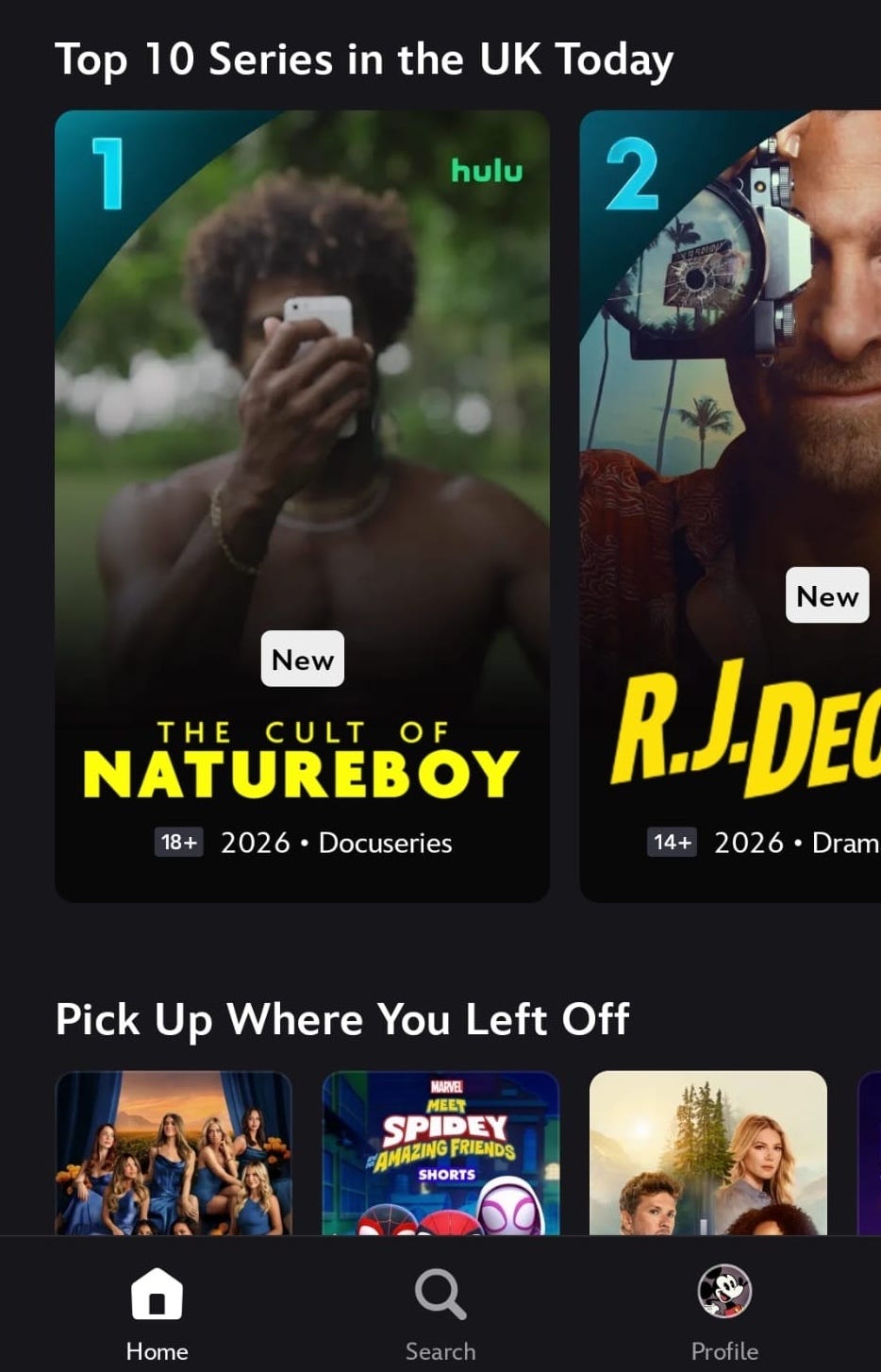
Our latest series for Disney+, The Cult of NatureBoy, launched yesterday in the UK, and it has been the number one show on the platform since it went live.
This is a story I first came across in 2017. Years of development, uncertainty, waiting for a legal process to conclude, and staying close to people who had been through something genuinely traumatic and needed enormous care. That it’s now the most watched thing on one of the biggest platforms in the UK after performing extremely well in the US is a testament to everyone who worked on it and those who were brave enough to talk to us.
If you’re in the UK and haven’t seen it yet, it’s on Disney+ now. I’d love to know what you think.
And in case you missed our last film
We got a millionaire to sit down with a homeless man. Hundreds of thousands of people have now watched it, which is brilliant. But the bit that has genuinely floored me is that members of the Zandland community have bought Larry’s poetry book to the tune of thousands of dollars.
That has genuinely changed his life. A 63 year old army veteran who was sleeping on the patio of a sports bar is has now sold a huge amount of copies of his books, because people who watched the film decided to do something about it. So if you were one of them, thank you. .
If you haven’t seen it yet, it’s on our YouTube now, and Larry’s book is linked in the description.
If any of this resonated, forward it to someone thinking about these questions.
If someone sent this to you, subscribe at newsletter.zand.land.
— Ben